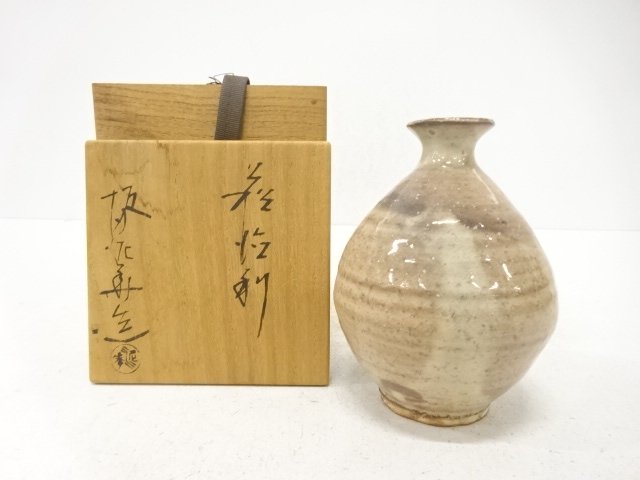
Excellent condition. * Items come with everything pictured (e.g. boxes, accessories, etc. if any).
* Please read through our store policy pages before ordering. Our store primarily sells vintage & antique wares.
Please understand that age affects both item condition and value as a collectible.
Check the condition in each photo carefully to help you decide whether to bid or buy.
If there is anything specific you would like to know about this item, please contact us.
Item Code:7819260
Size (cm)
サイズ
口径
高台径
高さ
縦
横
長さ
3.5
5
13.5
?Ask about this item
You must be logged in to ask a question.
Please log in and try again.
[Hagi ware]
One of the most famous Japanese ceramics produced in Yamaguchi prefecture, that is also called as "Korai ware".
In 1604, the Korean potter brothers, Li Shakuko and Li Kei, were invited to Hagi domain (present Yamagichi) by the feudal load Terumoto MORI. Under the patronage of Mori Terumoto, they established the kiln and produced ceramic which became the origin of Hagiware.
Hagi ware has humble forms and it has firing-denatured patterns/colors. Because it has tiny cracklings on surface , the color of Hagi ware gradually changes as water percolates from inside to outside through cracklings. This unique phenomenon is called "7 changes of Hagi ware".
From ancient times, Hagi ware has been admired by tea masters. There is a saying among them; " Ichi Raku, Ni Hagi, San Karatsu" which means "First-Raku, Second-Hagi, Third-Karatsu".
[Deika SAKATA]
Deika SAKATA is a family of traditional craftsmen which succeeded potteries generation to generation.
- First Generation (Ri Shaku Kou)
The father of Hagi- yaki (Hagi wares, a type of Japanese potteries used white glaze) and an ancestor of the Sakata family.
- Second Generation (Deika SAKATA) ? -1658
- Third Generation (Deika SAKATA) ? -1709
- Fourth Generation (Deika SAKATA) ? -1724
- Fifth Generation (Deika SAKATA) ? -1760
- Sixth Generation (Deika SAKATA) ? -1770
- Seventh Generation (Deika SAKATA) ? -1792
- Eighth Generation (Deika SAKATA) ? -1805
- Nineth Generation (Deika SAKATA) ? -1818
- Tenth Generation (Deika SAKATA) ? -1886
- Eleventh Generation (Deika SAKATA) ? -1919
- Twelveth Generation (Deika SAKATA) ? -1934
- Thirteenth Generation (Deika SAKATA) 1915 - 2010
A son of the 12th Deika. Name is Ippei, but he was called “Tenni” or “Deiju”. Born in Nagato city, Yamaguchi prefecture in Japan.
He was the head of the 13th and 14th of the family of Japanise traditional craftsmen).
History:
1933- He graduated Hagi Commercial High School. He learned potteries from his father, and devoted himself to the family business.
1950- He succeeded the 13th head of the family.
1964- He was accepted as a full member of Japan Art Crafts Association.
1968- He received a commission of a judge at the Yamaguchi Art exhibition.
1975- His works at the Tokyo Mitsubishi exhibition were bought by the Imperial Household Agency.
1976- He was inaugurated to the executive director of the Nihon Kogeikai (the Japan Art Crafts Association).
2004- His son, Keizo, died early so he conferred the honor of the 15th head of the family on Keizo. Deika called himself “Deiju”.
He was deeply fascinated with Ido Chawan (tea bowls), so he studied Ido Chawan harder and dedicated himself to create new ones. As a result, he succeeded establishing his own style of Ido Chawan, called “Deika Ido”. And he had another style, called “Hakuri-yaku (separating glaze, literally)”. Hakuri-yaku is a method of making potteries with separating glaze from a pottery when you fire it and expressing spotted patterns. He also had unique technique of potter’s wheels.
He has gotten awards several times:
* Yamaguchi Geiutsu Bunka Shinko Shoreisho (Yamaguchi Arts and Culture Promotion Awards in 1965
* Chugoku Bunkasyo (Chinese Cultural Awards) in 1970
* Important Intangible Cultural Proppet in 1972
* A Purple Ribbon Medal in 1981…ect
- Fourteenth Generation (Deika SAKATA)
Same person as the 13th Generation of Deika SAKATA.
- Fifteenth Generation (Deika SAKATA) 1949 - 2004
A son of the 13th (the 14th) Generation of Deika. The name is Keizo SAKATA.
Confirmation
Your question will be posted on the item page.
When answered, it will appear in the "Questions & Answers" section.
If the content is inappropriate, contains personal information, or is deemed unsuitable, it may not be answered or posted.
If everything is okay, please press "Submit".
Submitting...
SALE
JAPANESE COLLECTIBLE / HAGI-YAKI / CREATED BY SAKATA DEKA / SAKE BOTTL
Excellent condition. * Items come with everything pictured (e.g. boxes, accessories, etc. if any).
* Please read through our store policy pages before ordering. Our store primarily sells vintage & antique wares.
Please understand that age affects both item condition and value as a collectible.
Check the condition in each photo carefully to help you decide whether to bid or buy.
If there is anything specific you would like to know about this item, please contact us.
Item Code:7819260
[Hagi ware]
One of the most famous Japanese ceramics produced in Yamaguchi prefecture, that is also called as "Korai ware".
In 1604, the Korean potter brothers, Li Shakuko and Li Kei, were invited to Hagi domain (present Yamagichi) by the feudal load Terumoto MORI. Under the patronage of Mori Terumoto, they established the kiln and produced ceramic which became the origin of Hagiware.
Hagi ware has humble forms and it has firing-denatured patterns/colors. Because it has tiny cracklings on surface , the color of Hagi ware gradually changes as water percolates from inside to outside through cracklings. This unique phenomenon is called "7 changes of Hagi ware".
From ancient times, Hagi ware has been admired by tea masters. There is a saying among them; " Ichi Raku, Ni Hagi, San Karatsu" which means "First-Raku, Second-Hagi, Third-Karatsu".
[Deika SAKATA]
Deika SAKATA is a family of traditional craftsmen which succeeded potteries generation to generation.
- First Generation (Ri Shaku Kou)
The father of Hagi- yaki (Hagi wares, a type of Japanese potteries used white glaze) and an ancestor of the Sakata family.
- Second Generation (Deika SAKATA) ? -1658
- Third Generation (Deika SAKATA) ? -1709
- Fourth Generation (Deika SAKATA) ? -1724
- Fifth Generation (Deika SAKATA) ? -1760
- Sixth Generation (Deika SAKATA) ? -1770
- Seventh Generation (Deika SAKATA) ? -1792
- Eighth Generation (Deika SAKATA) ? -1805
- Nineth Generation (Deika SAKATA) ? -1818
- Tenth Generation (Deika SAKATA) ? -1886
- Eleventh Generation (Deika SAKATA) ? -1919
- Twelveth Generation (Deika SAKATA) ? -1934
- Thirteenth Generation (Deika SAKATA) 1915 - 2010
A son of the 12th Deika. Name is Ippei, but he was called “Tenni” or “Deiju”. Born in Nagato city, Yamaguchi prefecture in Japan.
He was the head of the 13th and 14th of the family of Japanise traditional craftsmen).
History:
1933- He graduated Hagi Commercial High School. He learned potteries from his father, and devoted himself to the family business.
1950- He succeeded the 13th head of the family.
1964- He was accepted as a full member of Japan Art Crafts Association.
1968- He received a commission of a judge at the Yamaguchi Art exhibition.
1975- His works at the Tokyo Mitsubishi exhibition were bought by the Imperial Household Agency.
1976- He was inaugurated to the executive director of the Nihon Kogeikai (the Japan Art Crafts Association).
2004- His son, Keizo, died early so he conferred the honor of the 15th head of the family on Keizo. Deika called himself “Deiju”.
He was deeply fascinated with Ido Chawan (tea bowls), so he studied Ido Chawan harder and dedicated himself to create new ones. As a result, he succeeded establishing his own style of Ido Chawan, called “Deika Ido”. And he had another style, called “Hakuri-yaku (separating glaze, literally)”. Hakuri-yaku is a method of making potteries with separating glaze from a pottery when you fire it and expressing spotted patterns. He also had unique technique of potter’s wheels.
He has gotten awards several times:
* Yamaguchi Geiutsu Bunka Shinko Shoreisho (Yamaguchi Arts and Culture Promotion Awards in 1965
* Chugoku Bunkasyo (Chinese Cultural Awards) in 1970
* Important Intangible Cultural Proppet in 1972
* A Purple Ribbon Medal in 1981…ect
- Fourteenth Generation (Deika SAKATA)
Same person as the 13th Generation of Deika SAKATA.
- Fifteenth Generation (Deika SAKATA) 1949 - 2004
A son of the 13th (the 14th) Generation of Deika. The name is Keizo SAKATA.
Item Code:7819260
Size (cm)
サイズ
口径
高台径
高さ
縦
横
長さ
3.5
5
13.5
?Ask about this item
You must be logged in to ask a question.
Please log in and try again.
Confirmation
Your question will be posted on the item page.
When answered, it will appear in the "Questions & Answers" section.
If the content is inappropriate, contains personal information, or is deemed unsuitable, it may not be answered or posted.