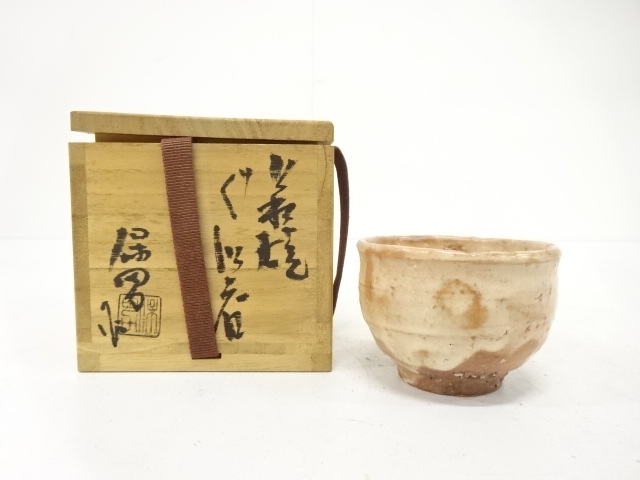
This item will be shipped as is (i.e. the same condition it was in when originally purchased from the antique dealer). * Items come with everything pictured (e.g. boxes, accessories, etc. if any).
* Please read through our store policy pages before ordering. Our store primarily sells vintage & antique wares.
Please understand that age affects both item condition and value as a collectible.
Check the condition in each photo carefully to help you decide whether to bid or buy.
If there is anything specific you would like to know about this item, please contact us.
Item Code:7660430
Size (cm)
サイズ
口径
高台径
高さ
縦
横
長さ
6.5
3.5
4.8
?Ask about this item
You must be logged in to ask a question.
Please log in and try again.
[Yasuo YAMATO]1933-
A Hagi ware potter in Yamaguchi city, Yamaguchi prefecture.
Yasuo Yamato was born in Yamaguchi as the second son of the 11th generation of Harunobu Yamato.
He has won many prizes at such as the Kofukai Exhibition and the West Japan Crafts Art exhibition, and produced ceramic walls for the Yamaguchi Museum, Tokuyama Culture Hall and the government building of Yamaguchi Prefecture and the monument for Atomic Bomb Victims in Hiroshima.
He was designated as an Intangible cultural property designated by Yamaguchi Prefecture in 1988. In addition, he was awarded several honorable awards; the Award for Distinguished Service to Art by Yamaguchi Prefecture in 1989, the Chugoku Cultural Award in 1992, the Japan Art Crafts Association Award in 2005, and the Order of the Rising Sun, Gold Rays with Rosette in 2007.
In 1995, Yasuo was presented his pseudonym “Tsugen” by the chief priest of Tofukuji temple in Kyoto. His “Ensai Otsubo” was preserved on Ise Shrine in 2000, and “ Kaime Tohbako” on Yakushiji temple in Nara in 2002.
Yasuo invented new methods called “Enhaku” to cause red discoloring by coating surface of pottery with dense salt water, and has produced large works such as ceramic walls as well as tea utensils.
[Hagi ware]
One of the most famous Japanese ceramics produced in Yamaguchi prefecture, that is also called as "Korai ware".
In 1604, the Korean potter brothers, Li Shakuko and Li Kei, were invited to Hagi domain (present Yamagichi) by the feudal load Terumoto MORI. Under the patronage of Mori Terumoto, they established the kiln and produced ceramic which became the origin of Hagiware.
Hagi ware has humble forms and it has firing-denatured patterns/colors. Because it has tiny cracklings on surface , the color of Hagi ware gradually changes as water percolates from inside to outside through cracklings. This unique phenomenon is called "7 changes of Hagi ware".
From ancient times, Hagi ware has been admired by tea masters. There is a saying among them; " Ichi Raku, Ni Hagi, San Karatsu" which means "First-Raku, Second-Hagi, Third-Karatsu".
Confirmation
Your question will be posted on the item page.
When answered, it will appear in the "Questions & Answers" section.
If the content is inappropriate, contains personal information, or is deemed unsuitable, it may not be answered or posted.