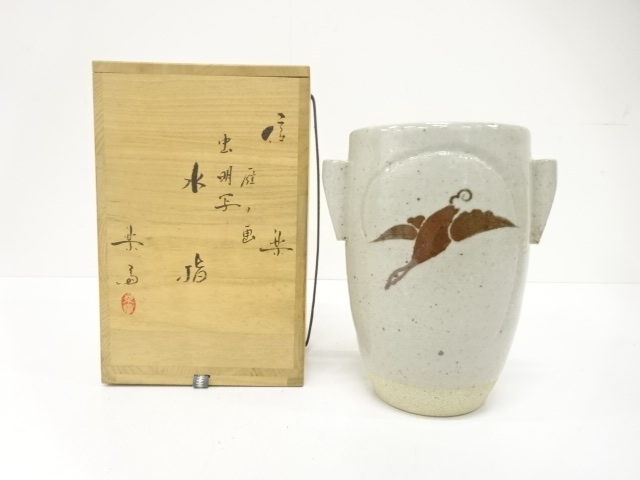
This item will be shipped as is (i.e. the same condition it was in when originally purchased from the antique dealer). * Items come with everything pictured (e.g. boxes, accessories, etc. if any).
* Please read through our store policy pages before ordering. Our store primarily sells vintage & antique wares.
Please understand that age affects both item condition and value as a collectible.
Check the condition in each photo carefully to help you decide whether to bid or buy.
If there is anything specific you would like to know about this item, please contact us.
Item Code:7613597
Size (cm)
サイズ
口径
高台径
高さ
縦
横
長さ
12.3
8
21
?Ask about this item
You must be logged in to ask a question.
Please log in and try again.
If you haven't signed up to our site, click here to do so.
[Shigaraki ware]
One style of Japanese pottery made around Shigaraki area in Shiga prefecture. It is one of Japan’s Six Ancient Kilns.
By around the end of the medieval period, potters in Shigaraki were making daily utensils such as jars, vats, and mortars using anagram kilns.
Because the beauty of its worm reddish hiiro(scarlet) flashing, deep green natural ash biidoro glaze and black scorching attracted Sen No Rikyu and other tea masters, Shigaraki got to be known as Tea pottery.
Shigaraki ware was designated by Japanese government as a traditional craft in 1976 and there are over 300 kilns today.
Shigaraki ware is famous for statures of tanuki (a small raccoon dog) that are often settled in front of shops and restaurants as a lucky charm (the word “tanuki” can mean “excel past the competition” in Japanese). The history of Tanuki statures began in Meiji period when the potter Tetsuzo Fujiwara in Shiga made tanuki for the first time.
[Takahashi Rakusai]
The 1st generation : Takahashi Rakusai
The 2nd generation : Takahashi Rakusai
The 3rd generation (Takahashi Rakusai) (1898 - 1976)
Born in Shiga prefecture in Japan, name is Kounosuke.
In 1915, he learned potteries in the Kyoto Potteries Training Institute, and he worked for potteries diligently in Shigaraki city in Shiga.
In 1917, he succeeded the 3rd head of Rakusai, and he was acknowledged as a preserver of the technique of Shigaraki wares in 1941.
There was achievement on his potteries at exhibitions or museums inside or outside country, so he was acknowledged as Intangible Cultural Property by Shiga prefecture in 1964.
In 1971, he took an award for the most valuable craftsman by the Labor Minister.
He has been praised highly as a skillful craftsman on Modern Shigaraki, creating potteries mixed with style of Old Shigaraki wares or Old Iga wares.
The 4th Generation (Takahashi Rakusai) (1925)
Born in Shiga, name is Mitsuo.
In 1973, he was invited to visit Los Angeles, the U.S.A., and had an exhibition in the country.
He gave lectures and instructed about potter’s wheels at the California University, and he was engaged in potteries widely.
In 1976, he succeeded the 4th Rakusai and he was acknowledged as a traditional craftsman.
In 1991, he was awarded the International Arts and Culture Award.
Takahashi Syunsai (1927)
Born in Shiga, as a second son of the 3rd Rakusai.
His father, the 3rd Rakusai, was Syunsai’s teacher on potteries. Syunsai worked the family’s business diligently.
In 1968, he created “Syunsai pottery”, and he became independent on business.
In 1995, Syunsai pottery was acknowledged as Intangible Cultural Property by Shiga prefecture.
He died in 2011, when he was 84 years old.
Confirmation
Your question will be posted on the item page.
When answered, it will appear in the "Questions & Answers" section.
If the content is inappropriate, contains personal information, or is deemed unsuitable, it may not be answered or posted.