Slight stains/starch spots, but otherwise in excellent condition for its age (i.e.taking into account its antique status). Excellent condition for its age (i.e.taking into account its antique status). *Attention*
- For fabric crafts or for display purpose. (Not recommend for actual wearing.)
- Be aware of it antique nature; there may or may not be some minor dirt/oil marks/material flaws/sewing faults/color faults etc.
Plus, there may possibly be some other imperfection which cannot appear in the photos.
- Description about the conditions of its lining and its collar is not provided. * Items come with everything pictured (e.g. boxes, accessories, etc. if any).
* Please read through our store policy pages before ordering. Our store primarily sells vintage & antique wares.
Please understand that age affects both item condition and value as a collectible.
Check the condition in each photo carefully to help you decide whether to bid or buy.
If there is anything specific you would like to know about this item, please contact us.
Item Code:7608056
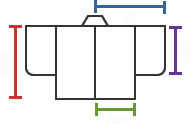
Size (cm)
Length
154
Sleeve width at shoulder
62
Sleeve width
58
?Ask about this item
You must be logged in to ask a question.
Please log in and try again.
[Katazome]
katazome is the japanese traditional method of dying fabrics using resist paste applied through a stencils.
Pigment is added by hand-painting using hake (brush), and dyes are usually only applied from one side of the fabric.
[Ryukyu bingata]
Ryukyu bingata is an Okinawan traditional resist dyed cloth. The bold patterns and bright red, yellow, blue and green colors of bingata are dyed with the aid of a starch. This starch can be applied to the cloth through a pattern stencil or freehand(called tsutsugaki). It dates from the 13th century when Ryukyu Kingdom administered the islands. Under the protection of Ryukyu kingdom, Ryukyu bingata was often used as offerings to Edo shogunate, China, Korea and other countries. Today, the dying technique of Bingara continues to be made as a traditional art in Okinawa.
While most of bingata designs are colorful, many of Ko-bingata (the older styles) have designs of Chinese auspicious omen motifs painted in subdued colors.
Confirmation
Your question will be posted on the item page.
When answered, it will appear in the "Questions & Answers" section.
If the content is inappropriate, contains personal information, or is deemed unsuitable, it may not be answered or posted.