Chafing, but otherwise in excellent condition for putting on. * Items come with everything pictured (e.g. boxes, accessories, etc. if any).
* Please read through our store policy pages before ordering. Our store primarily sells vintage & antique wares.
Please understand that age affects both item condition and value as a collectible.
Check the condition in each photo carefully to help you decide whether to bid or buy.
If there is anything specific you would like to know about this item, please contact us.
Item Code:7525737
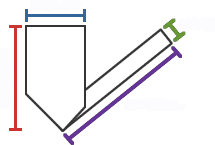
Size (cm)
Taiko part length
113
Largeur de la partie Taiko
31
Taiko part width
244
Front part width
15.5
?Ask about this item
You must be logged in to ask a question.
Please log in and try again.
If you haven't signed up to our site, click here to do so.
[Kawashima Selkon]
A Nishijin brocade store of long standing since 1843.
In 1843, the 1st Kawashima Jinbē established it.
In 1879, Benjirō succeeded the 2nd Jinbē, the 2nd head of the family.
In 1888, Benjirō manufactured ornamental textiles in the room of the Meiji Palace. He turned out to be the first artisan of ornamental textiles in the country. Thus, he became the first purveyor for a palace room in the country.
In 1910, the 2nd Jinbē died. The 3rd Kawashima Jinbē succeeded the head of the family.
In 1938, he reformed the store to a corporate organization, and established “Kawashima Orimono Jinbē Inc. Store”.
The next year he changed the store’s name to “Kawashima Orimonosyo Inc.”.
In 1957, he changed it to “Kawashima Orimono Inc.”.
* ”orimono” means “textile” or “fabric”.
In 1974, Jinbē producted ornamental textlies within the room of Akasaka Palace. Jinbē received a praise from the Prime Minister at that time.
In 1996, Jinbē took part in a restored article of the Shosoin treasures, “Ashiginu Itten”.
In 2005, he supplied one of his works, “Reika” (rei = beautiful or elegant, ka = flower), which is a type of Tuzureori wall pictures at the dinner room of Kyoto Guest House.
Confirmation
Your question will be posted on the item page.
When answered, it will appear in the "Questions & Answers" section.
If the content is inappropriate, contains personal information, or is deemed unsuitable, it may not be answered or posted.