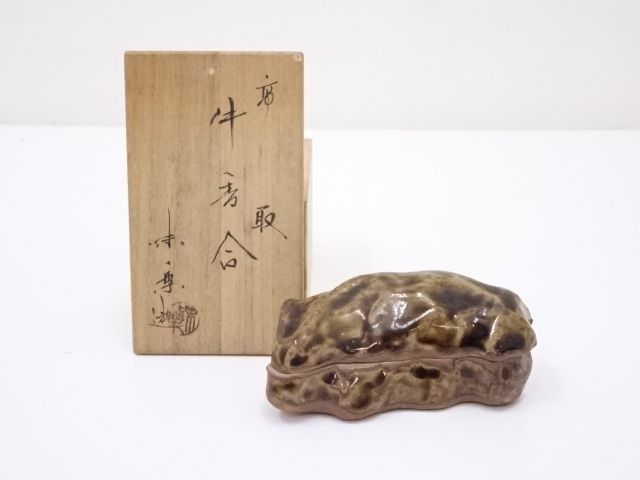
Stains, but otherwise in excellent condition.
Note: fragile This item will be shipped as is (i.e. the same condition it was in when originally purchased from the antique dealer). * Items come with everything pictured (e.g. boxes, accessories, etc. if any).
* Please read through our store policy pages before ordering. Our store primarily sells vintage & antique wares.
Please understand that age affects both item condition and value as a collectible.
Check the condition in each photo carefully to help you decide whether to bid or buy.
If there is anything specific you would like to know about this item, please contact us.
Item Code:4397416
Size (cm)
サイズ
口径
高台径
高さ
縦
横
長さ
4.2
4.6
9.3
?Ask about this item
You must be logged in to ask a question.
Please log in and try again.
If you haven't signed up to our site, click here to do so.
[Takatori Ware]
One style of Japanese pottery that has been produced around Naokata city and Sawara area in Fukuoka City, Fukuoka prefecture. It has more than 400 years history and Katatori ware is one of the best kilns selected by Enshu KOBORI.
The load of Bizen domain Nagamasa KURODA took back a Korean potter Hachizan when Nagamasa joined war in Korea, then he established a kiln at the foot of Mt. Takatori(present Nogata city, Fukuoka prefecture). Then Maneiji kiln (established in 1606), Uchigasi kiln (1612) and Yamada kiln (1616) were established under the patronage of the Load Kuroda. Works made at those 3 kilns are called as “Ko(old) Takatori “.
Takatori ware flourished as official kils of the load Kuroda during Edo period then they moved to Hakkisan kiln and received guidance from Enshu KOBORI, a famous tea master, in Kanei era. Tat that time, potters made lots of Enshu favored chawan and tea utensils and they are called “Enshu Takatori”.
At a mater time, Hachiro who was the grandson of Hachizan moved the kiln in Koishihara, Asakura district and made delicate works called “Koishikawa Takatori”. Then the kiln moved to Ogaya in Fukuoka and Takatori split into Higashi Sarayaka kiln and Nishi Sarayama kiln in the 18th century.
Over rising and falling, methods and techniques of Takatori ware has been succeeded until today. Takatori ware kilns create works with 7 kinds of traditional glazes (Takamiya glaze, copper glaze, Furashi glaze, white glaze, black glaze, yellow glaze and blue green glaze) and various kinds of new glazes.
[Miraku KAMEI]
A Takatori ware pottre in Sawara area in Fukuoka city.
The founder of the family is Hachizan, the originator of Takatori ware. The 13th generation Yataro started to use the name “Miraku KAMEI" and it has been succeeded until the present master, the 15th generation Miuraku.
-First Generation : Hachizan (the originator of Takatori ware)
-Second Generation : Tadaaki Hachizo
-Third Generation : Tadahisa Hachizo
-Fourth Generation : Hachikuro
-Fifth Generation : UIchirosuke Sadakatsu
-Sixth Generation : Yasutsugi Tadakatsu
-Seventh Generation : Ichiro Arisada
-Eighth Generation : Kazuhira Norichika
-Ninth Generation : Takehira Miraku
-Tenth Generation : Wasaburo Teien
-Eleventh Generation : Kyusuke Jusen
-Twelfth Generation : Tokusaburo Shigetada
-Thirteenth Generation : Miraku KAMEI(1883-1956)
The eldest son of the 11th generation Kyusuke Jusen. His real name was Yataro, his art name was Miraku.
The feudal domain system was abolished and potters lost a patronage from the load, then they needed to be an entrepreneur. He changes his family name as “Kamei” after Kameibou, a training seminary for monks on Mt. Houman.
He was good at making tea utensils and recognized as a holder of authorized preserver of techniques in 1944.
-Fourteenth Generation : Miraku KAMEI (1931-2014)
The gland son of the 13th generation Miraku. His real name was Genhachiro, art name was Miraku/Souseian.
After he graduated Syuyukan Highschool, he refined his skills under his grand father from 1946. He succeeded the 14th generation Miraku in 1964 and designated as an intangible cultural properties by Fukuoka city.
He won many prizes at Fukuoka Art Exhibition, Seibu Art Crafts Exhibition, Western Japan Ceramic Art Exhibition and other exhibitions,
He received a doctor's degree of Art at Century University in the US in 1992
He entered the Buddhist priesthood in 2001 and received the name “Souseian” from Soutan SETTEI, the 520th chief priest of Daitoku-ji Temple. At the same year, he was awarded the Medal with a Yellow Ribbon for industriousness.
-Fifteen Generation : Miraku KAMEI (1960-)
The eldest son of the 14th generation. His real name is Masahisa. The present generation.
He graduated the pottery course at Kyoto Saga Art University in 1981 and received a doctor's degree of Art at Century University in the US in 1992. He succeed the 15th generation Miraku in 2001.
He won many prizes at Fukuoka Art Exhibition, Western Japan Art Craft Exhibition, Japan Ceramic Art Exhibition, the Japan Traditional Art Crafts Exhibition and so on and has held his personal exhibitions at many cities in Japan.
A member of Fukuoka Art Association and Fukuoka Ceramic Society.
Confirmation
Your question will be posted on the item page.
When answered, it will appear in the "Questions & Answers" section.
If the content is inappropriate, contains personal information, or is deemed unsuitable, it may not be answered or posted.