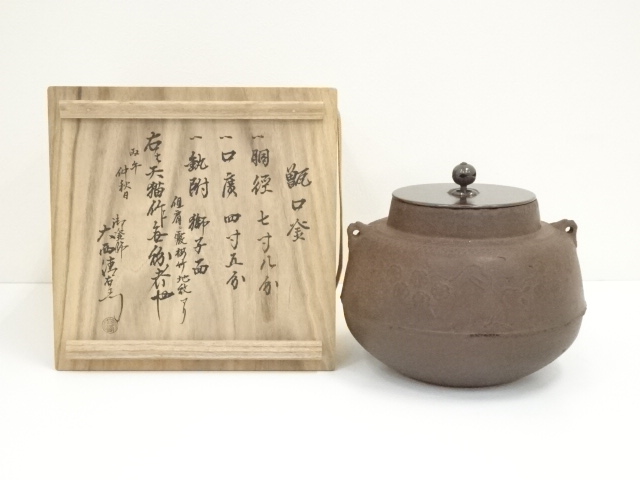
This item will be shipped as is (i.e. the same condition it was in when originally purchased from the antique dealer).
* Items come with everything pictured (e.g. boxes, accessories, etc. if any).
* Please read through our store policy pages before ordering.
Our store primarily sells vintage & antique wares.
Please understand that age affects both item condition and value as a collectible.
Check the condition in each photo carefully to help you decide whether to bid or buy.
If there is anything specific you would like to know about this item, please contact us.
[Ōnishi Sei’emon]
One of the Senke Jissoku, “The Ten Craftsmen of the House of Sen”. He was Kama-shi, cauldron artist. Kama is a cauldron to heat water for tea ceremony. It is often placed on top of Furo, or Buro, brazier. In the beginning of Edo period (1603-), he created cauldrons in Kamanza, Sanjo, Kyoto.
- First Generation: Jōrin (1590-1663)
Jorin was born in Hirose village, Minami-Yamashiro, in Yamashiro-no-kuni (the southeast part of Kyoto prefecture). In the beginning, his last name was Hirose. His first name was Jinbe’e. Later, he moved to Kyoto and became a disciple of cauldron craftsman Nagoshi Sansho, or “Jōmi”.
- Second Generation: Jōsei (1594-1663)
He was commonly called Goroza’emon. His real name was Soncho. He was a younger brother of Jōrin, the first generation. He created cauldrons for Furuta Oribe, the tea master-founder of Oribe style and Oda Yūraku, one of the tea artists/practitioners of Rikyu. Kobori Masakazu, the tea master-founder of Enshūryū style also favored his cauldrons. With his son Teirin, he was summoned by Tokugawa shogun family and had to travel to Edo, then capital city (today’s Tokyo). His cauldrons were thin-bodied. His delicate and precise craftsmanship well appeared in Kegiri (a joint thin line of upper and lower bodies of cauldron), and Kantsuki (small handles attached on the sides of a cauldron). In addition to cauldrons, his creations include Bronze candle stands for Nikkōzan Daiyūin and Dai Bonshō (a large temple bell) for Shinagawa-dera Temple in Edo, Tokyo. His child, Teirin moved to Edo and settled down there. He founded Edo Ōnishike (Ōnishi family).
- Third Generation: Jōgen 1630-1684
His common name was Jinbe’e. He inherited styles of Jōrin, the first generation and Jōshin, the second generation. He was also well-known for researching on Kamahada, the surfaces of cauldrons.
- Forth Generation: Jōton (1645-1700)
His common name was Sei’emon. He created cauldrons especially suitable for larger Shōin (personal office/library) style rooms.
- Fifth Generation: Jōnyu (1647-1716)
His common name was Shinbe’e. He was a younger brother of Jōton, the forth generation master. His cauldrons were different from the Kyoto style. His Suna-hada (“Sand skin”) style was especially distinctive. The surface of cauldrons was mat, coarse, and sand soil like finish.
- Sixth Generation: Jōgen (1689-1762)
His childhood name was Seikichi, later changed to Sei’emon. His real name was Shigeyoshi. He was a child of Jōton, the forth generation master. Since this cauldron master of the sixth generation, the family officially served as the cauldron craftsman for Omotesenke “Front Sen family”. Jōgen created Tsurukubi Gama: the top opening of this cauldron is narrower and its entire shape resembles a pear. He also created Raisei Gama, a wide, cylinder shaped cauldron with characters “Raisei”, carved on the surface. These cauldrons were favorites of Joshinsai, the seventh generation Omotesenke tea master. The style of Jōgen’s cauldrons was Chu-Arahada, “medium coarse skin or finish”. It was similar to that of Tsuji Yojiro, a cauldron craftsman for Toyotomi Hideyoshi, Japan’s second “great unifier” of the 16th century Japan and Rikyu. He also created Kohada (polished skin or finish). It was also notable that his cauldrons used Yakinuki manufacturing procedure: after the cauldron is cast, it is placed back to the kiln and heated again at 800 degrees centigrade in order to even out the surface and coat with oxide film. He used a seal “Kamaya Jōgen” on boxes and a round seal “Hosono”. To classify Jōgen with Jōgen of the ninth generation master, this Jōgen was also called Furu Jōgen “Old Jōgen”.
- Seventh Generation: Jōgen (1720-1783)
His childhood name was Seikichi, later, Sei’emon. His real name was Hidekazu. He was a child of Jōgen, the sixth generation master. He created Gennoji Gama, favored by Sotsutakusai, the tea master of Omotesenke “Front Sen Family”. Gen no Ji Gama is a cauldron whose shape is as the same as Amidado Gama, with a character “Gen” on the bottom part. Jogen was also skillful at creating Karadō-Buta, Chinese-style bronze lids and Kuchiatsu Reicha. His works were commonly known as “Kuro-Gen”.
- Eighth Generation: Jōhon (1747-1785)
He was married with the granddaughter of Jōgen, the sixth generation master. He became the adopted son of Jōgen, the seventh generation master. His name was Kanemitsu.
- Ninth Generation: Jōgen (1749-1812)
He was as pupil of Jōgen, the seventh generation master. His real name was Okudaira Sahe’enoyuki. His childhood name was Minosuke. His common name was Sahe’e and his real name was Yasufusa. Jōhon, the eighth generation master died young without having an heir. Sokutatsusai, the tea master of Omotesenke “Front Sen family” at that time sponsored and mediated the heir nomination. As a result, Jōgen succeeded as the ninth generation master. However, all his life he continuously named himself Sahe’e and used seal “Okudaira”.
- Tenth Generation: Jōsetsu (1777-1852)
His childhood name was Seikichi. Later he changed to San’emon and Sei’emon. His real name was Nagataka. He was the eldest son of Jōgen, the ninth generation. In 1817, He was given a handwritten Jōsetsu name by Ryōryōsai, the ninth tea master of Omotesenke “Front Sen family”. Jōsetsu created many distinguished pieces including Koshikiguchi Hiragama (a round shape cauldron with straight-up short cylinder-opening on top) especially favored by Ryōryōsai.
- Eleventh Generation: Jōju (1808-1875)
His childhood name was Seikichi. Later he changed to San’emon and Sei’emon. His real name was Michitaka. He was the adopted son of Jōsetsu, the tenth generation master. Jōju created cauldrons and works for Kyūkosai, the tenth tea master of Omotesenke, “Front Sen family”, Rokurokusai, the eleventh, and Gengensai, the eleventh master of Urasenke “Back Sen family”.
- Twelfth Generation: Jōten (1841-1869)
His name was San’emon. He was the eldest son of Jōju, the eleventh generation master. He died young thus he left not so many works.
- Thirteenth Generation: Jōchō (1866-1934)
His childhood name was Seisaburo. His real name was Takanobu. He was the eldest son of Jōten, the twelfth generation master. Jōchō created works in accordance with the tastes of tea masters in that period respectively. In his later life, he became a connoisseur of cauldrons and followed expertise.
- Fourteenth Generation: Jōchu (1888-1960)
His childhood name was Seitaro. His real name was Takamichi. He was the eldest son of Jōchō, the thirteenth generation master. Jōchu created works for Sokuchūsai, the thirteenth generation tea master of Omotesenke “Front Sen Family”, and Tantansai, the fourteenth generation tea master of Urasenke “Back Sen Family”. It is said Jōchu participated in Zen teaching by Takeda Mokurai at The Oldest Zen Temple Ken’nin-ji in Kyoto.
- Fifteenth Generation: Jōshin (1924-2002)
His childhood name was Masusaburo. His real name was Takeo or Kensei. He was the second son of Jōchu, the fourteenth generation master. In 1960, Jōshin succeeded as the fifteenth generation master. He created Maru Gama, round shape cauldrons, favored by Jimyōsai, the fourteenth generation tea master of Omotesenke “Front Sen family”. He also created Chitose Gama for Hōunsai, the fifteenth generation tea master of Urasenke “Back Sen family”. Jōshin’s distinctive work is Shin’nari Gama called “Gasho”. Shin’nari Gama has the standard tea ceremony cauldron shape, with two small handles on both sides and thin joint line at the bottom. This Shinnari Gama was named Gasho, “a big pine tree over a big rock”. The detailed pine tree pattern surrounds the surface of the whole cauldron. The original design of this was made by Higashiyama Kaii, one of the greatest Japanese style painters of Showa period.
- Sixteenth Generation: present master (1961- present)
He is the eldest son of Jōshin, the fifteenth generation master. In 1993, he succeeded as Sei’emon, the sixteenth generation master.
Item Code:7048427
Size (cm)
サイズ
口径
高台径
高さ
縦
横
長さ
13.1
13.3
20.7
23.9
?Ask about this item
You must be logged in to ask a question.
Please log in and try again.
If you haven't signed up to our site, click here to do so.
Confirmation
Your question will be posted on the item page.
When answered, it will appear in the "Questions & Answers" section.
If the content is inappropriate, contains personal information, or is deemed unsuitable, it may not be answered or posted.